After water damage, you’ll often hear both terms thrown around as if they mean the same thing: “we need to do structural drying” and “we’ll bring in dehumidifiers” can sound like two ways of saying the same job. They’re related, but they describe two different parts of the same overall drying process. Understanding both helps you know whether a company is actually doing a complete job or just part of one.
What Is Dehumidification?
Dehumidification refers specifically to removing excess moisture from the air. A dehumidifier pulls humid air in, condenses the water vapor out of it, and releases drier air back into the room. This lowers the overall humidity level in the space, which matters because high ambient humidity slows down how quickly wet materials can release their own trapped moisture into the air.
Think of dehumidification as managing the air itself. Without it, the air in a room can become saturated with moisture pulled from wet materials, which actually slows the drying process down since materials struggle to release moisture into air that’s already humid.
What Is Structural Drying?
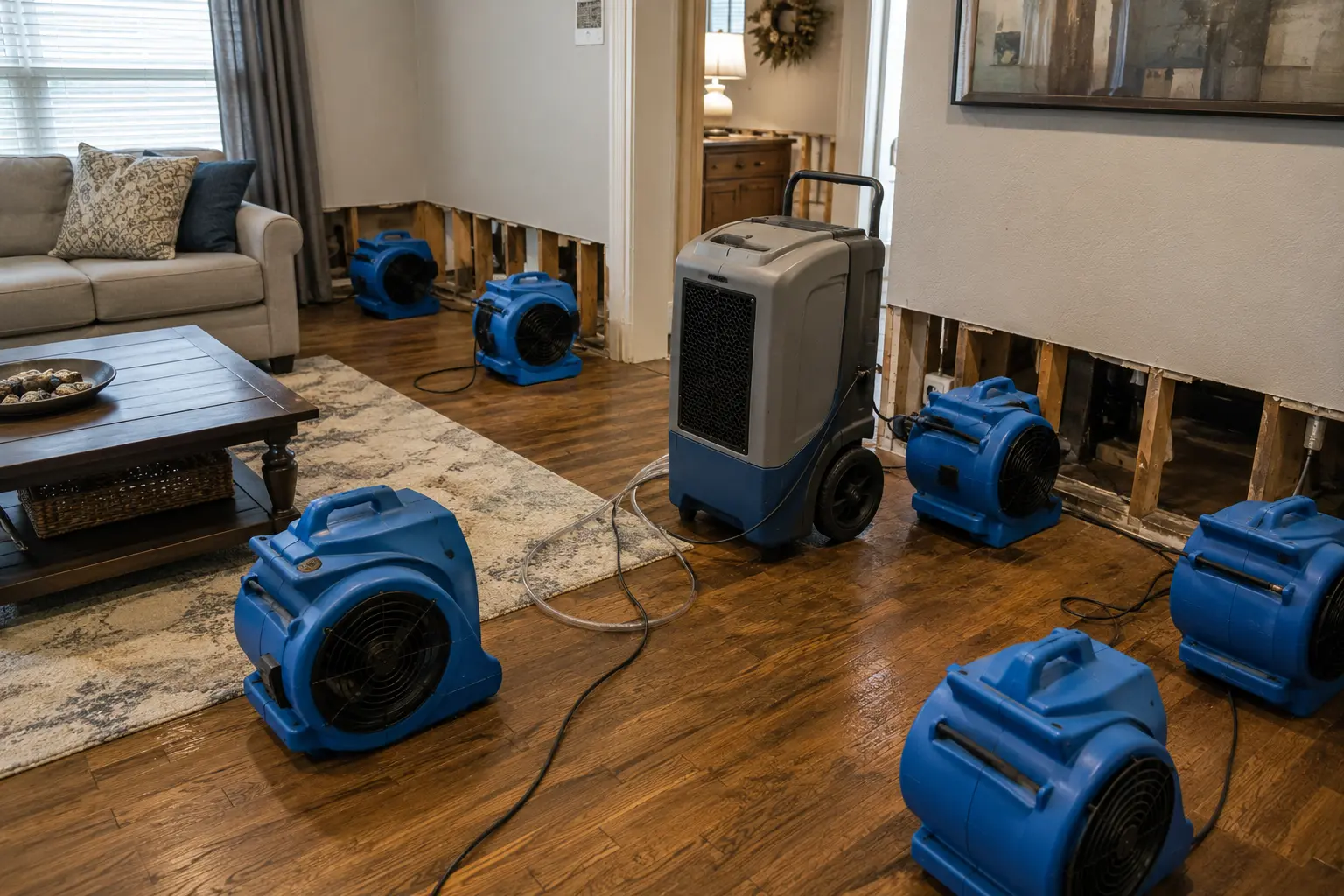
Structural drying is the broader process of removing moisture from the actual building materials, drywall, framing, subfloor, insulation, not just the air around them. This involves a combination of equipment and techniques working together:
- Air movers create airflow across wet surfaces, speeding up evaporation from materials like flooring, walls, and baseboards
- Dehumidifiers remove the moisture that’s been evaporated into the air, preventing it from resaturating nearby materials
- Moisture meters measure how much water content remains in specific materials, guiding decisions about how long drying needs to continue
- Sometimes specialized equipment like injection drying systems for wall cavities or floor mat systems for hardwood floors, depending on what’s affected
Structural drying is the complete system; dehumidification is one essential component within it. A job that only places dehumidifiers without proper air movement and without verifying moisture levels in the actual structure isn’t truly complete structural drying, even though the room might feel less humid.
Why You Need Both Working Together
Air movers and dehumidifiers work as a pair, and using one without the other significantly slows the process or can even stall it entirely.
Air movers alone, without dehumidification, push humid air around a room without actually removing the moisture from it. Eventually the air becomes so saturated that materials stop releasing moisture into it, and drying essentially plateaus.
Dehumidifiers alone, without air movers, can lower the humidity in a room, but without airflow directly across wet surfaces, those surfaces dry much more slowly since there’s no mechanism actively pulling moisture out of the material itself.
This is why a professional structural drying setup always combines both, calculated based on the size of the affected area, the type of materials involved, and how saturated they are.
How Technicians Decide How Much Equipment to Use
This isn’t guesswork. Industry-standard drying calculations (based on IICRC guidelines) take into account the square footage of the affected area, the class of water damage (how much of the structure absorbed water and how quickly it can release it), the type of materials involved, and the ambient temperature and humidity of the space. A technician under-equipping a job to save on rental costs is one of the more common shortcuts that leads to incomplete drying, which connects directly to the mold recurrence issues covered in our guide on why mold can come back after remediation.
How Long Does the Combined Process Typically Take?
For a standard, contained water event (a single room, clean water source, caught relatively quickly), structural drying with proper dehumidification typically takes 3 to 5 days. Larger affected areas, denser materials like hardwood or plaster, or water that sat for an extended period before mitigation began can extend this to a week or more. The only reliable way to know drying is complete is moisture meter readings returning to normal, dry baseline levels, not a fixed number of days or simply how the space feels.
Specialized Drying Situations
Hardwood floors often require specialized floor mat drying systems that pull moisture up through the wood from below, since standard air movers alone usually aren’t sufficient to dry solid hardwood without causing warping or cupping.
Wall cavities, particularly in cases where drywall wasn’t removed because moisture levels were within an acceptable range to dry in place, sometimes require injection drying systems that push dry air directly into the wall cavity through small access points.
Ceiling cavities, especially after a leak from above, can require a combination of removed drywall sections and targeted airflow into the remaining structure, covered in more detail in our guide on ceiling water damage repair.
What to Ask a Company About Their Drying Process
- How many air movers and dehumidifiers are being placed, and how was that number calculated?
- Will you provide daily moisture readings, and can I get copies?
- What specific moisture percentage or reading indicates the structure is fully dry?
- Do you use any specialized equipment for hardwood, wall cavities, or other materials in my home?
A company confident in their process should answer these clearly. See our broader guide on how to choose a water damage restoration company for more questions worth asking before hiring anyone.
Common Mistakes That Slow Down the Drying Process
Even with the right equipment on-site, a few common mistakes can significantly extend drying time or leave a property only partially dry:
- Closing off the room. Closing doors to “contain” the area being dried actually traps humid air and slows evaporation. Proper drying setups generally require airflow between connected spaces, not isolation, unless containment is specifically needed for contamination control.
- Turning off equipment too early. Surfaces often feel dry to the touch well before the materials underneath have released enough moisture, which is why relying on touch rather than a moisture meter leads to premature equipment removal.
- Insufficient air mover placement. Underestimating the number of air movers needed for a given square footage is one of the most common ways drying jobs get under-equipped, often to save on daily equipment rental costs.
- Ignoring building HVAC settings. Running air conditioning during the drying process (rather than just dehumidifiers and air movers) can sometimes interfere with the intended airflow pattern, depending on the setup, and should be coordinated with the technician rather than left running independently.
How Climate in Los Angeles Affects Drying Time
Los Angeles’ generally dry climate is actually an advantage for structural drying compared to more humid regions, since lower ambient outdoor humidity means dehumidifiers don’t have to work as hard to bring indoor humidity down to target levels. That said, this can vary seasonally and by microclimate, coastal-adjacent neighborhoods and homes without strong ventilation can run more humid than the regional average, which is worth factoring into a realistic drying timeline rather than assuming every job in the area dries at the same rate.
What Happens to Equipment Once Drying Is Confirmed Complete
Once moisture readings throughout the affected area confirm the structure has reached a safe, dry baseline (typically compared against an unaffected reference area in the same property for an accurate comparison), equipment is removed and a final report documenting the readings is typically provided. This report becomes part of the permanent record for the job and is often the document insurance adjusters specifically request when evaluating whether mitigation was completed appropriately before restoration began.
The Science Behind Why Air Movement Speeds Up Evaporation
It helps to understand the basic physics at play, since it explains why this combination of equipment works the way it does. Wet materials are surrounded by a thin layer of saturated air right at the surface, sometimes called the boundary layer. As long as that boundary layer stays saturated, evaporation from the material slows dramatically, since the air immediately surrounding the wet surface can’t absorb any more moisture. Air movers work by constantly disrupting and replacing that boundary layer with drier air, which allows evaporation to continue at a much faster rate. Dehumidifiers then ensure the air being circulated by those air movers actually has the capacity to absorb more moisture in the first place, rather than just recirculating air that’s already humid. This is the core reason these two pieces of equipment are designed to work as a system rather than independently.
How Temperature Affects the Drying Process
Warmer air holds more moisture than cooler air, which means temperature plays a meaningful role in drying efficiency. This is part of why some structural drying setups include controlled heating in addition to air movers and dehumidifiers, particularly during cooler months or in poorly insulated spaces. However, this needs to be balanced carefully, since excessive heat can cause certain materials (particularly hardwood flooring) to dry too quickly and unevenly, leading to cracking or warping rather than a clean, even dry-out. This is one of the reasons specialized equipment and trained judgment matter more than simply maximizing every variable (more heat, more airflow, more dehumidification) as aggressively as possible.
What “Class” of Water Damage Means for Equipment Calculations
IICRC standards classify water damage into four classes based on how much moisture has been absorbed into the structure and how readily it can be removed, ranging from Class 1 (minimal absorption, limited to a small area) to Class 4 (specialty drying situations involving materials with very low permeability, like dense hardwoods, plaster, or concrete, which release moisture extremely slowly). This classification, separate from the water category (clean, gray, black) discussed elsewhere, specifically drives how much equipment is needed and how long drying is expected to take, since a Class 4 situation in dense materials can take significantly longer to dry than a Class 1 situation even if the same square footage is affected.
Why Some Jobs Need Negative Air Pressure Equipment
In certain situations, particularly when contamination or mold is a concern alongside the moisture itself, technicians may set up negative air pressure machines in addition to standard air movers and dehumidifiers. These units pull air out of the affected space and filter it through HEPA filtration before releasing it, creating a slightly lower air pressure inside the work area relative to the surrounding space. This prevents contaminated air, whether from mold spores, sewage contamination, or fire-related particulates, from escaping into unaffected parts of the property while drying and cleanup work is underway. This is a more specialized setup than standard structural drying and is typically reserved for higher-risk situations rather than used on every job.
How Technicians Monitor Progress Without Constantly Visiting
For longer drying jobs, some companies now use remote monitoring sensors placed alongside the drying equipment, which transmit moisture and humidity readings back to the company without requiring a technician to physically visit and manually check meters every single day. This doesn’t replace in-person verification entirely, especially for the final readings confirming a space is ready for restoration, but it can provide more continuous data throughout the drying period and sometimes allows technicians to identify a stalled drying process (where readings plateau rather than continuing to improve) more quickly than a once-daily manual check might catch.
Quick Reference
| Dehumidification | Structural Drying |
|---|---|
| Removes moisture from the air | Removes moisture from building materials |
| One component of the drying process | The complete drying system (air movers, dehumidifiers, moisture monitoring) |
| Lowers ambient humidity | Restores materials to a safe, dry moisture content |
If you’re dealing with water damage anywhere in Los Angeles, our team calculates and deploys the right combination of air movers, dehumidifiers, and specialized equipment based on your specific situation, then verifies the structure is genuinely dry before any rebuilding begins.
Need professional structural drying right now? Call ASAP Water Damage Restoration for fast equipment deployment and full moisture documentation, available 24/7 across Los Angeles.
Keep reading
- How Long Does Structural Drying Take After a Flood?
- Moisture Mapping for Water Damage in Los Angeles
- Water Extraction vs Water Removal: What’s the Difference?
Need help now? See our Structural drying services or call (323) 677-2811, 24/7.